
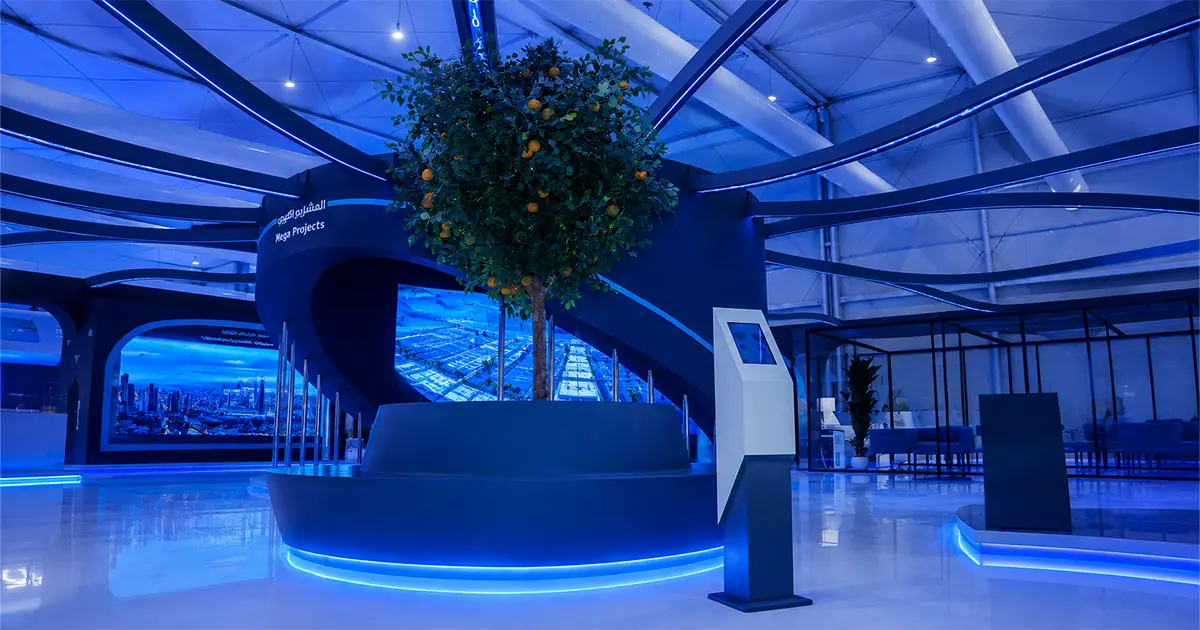
If you're exhibiting at a trade show or exhibition in Saudi Arabia, start planning your exhibition stand at least 8 to 16 weeks before the event, and allow 16 to 20 weeks or more for large, custom, or technically complex builds. There is no single lead time that applies to every project. The right timeline depends on stand size, design complexity, technical requirements, and how many approval rounds are involved. Here's what actually determines your timeline, and how to avoid the delays that push exhibitors past it.
These ranges reflect typical planning windows based on project complexity, not guaranteed production deadlines or fixed industry standards. Your builder's workload, material availability, and how quickly your team approves designs will all shift the exact timeline.
|
Stand type |
Recommended planning window |
|
Modular / rental |
4–6 weeks |
|
Shell scheme |
4–8 weeks |
|
Small custom |
8–10 weeks |
|
Medium custom |
10–14 weeks |
|
Large custom |
14–18 weeks |
|
Complex / double-deck |
16–20+ weeks |
Modular and rental stands move fastest because they use pre-engineered, existing components. Shell-scheme stands with custom graphics need a bit more time for design and print production. Custom stands take longer in direct proportion to their size and structural complexity, and double-deck builds need the most lead time because they require additional structural engineering and often extra approvals from the organiser or venue.
Technology-heavy stands, meaning anything with significant LED, AV, or interactive elements, tend to add several weeks on top of whatever base range applies, since equipment sourcing and integration testing take real time.
A few factors push a project toward the longer end of its range:
The project moves through a fairly consistent sequence: brief and budget, builder selection, concept design, client approval, technical drawings and engineering, organiser and venue approval, production and fabrication, graphics, logistics, installation, technical testing, and finally the event itself. A delay at any early stage, especially design approval, compresses everything that follows. That's the main reason rushed projects cost more: less time downstream to absorb problems.
Modular and rental stands are faster and generally more budget-friendly, using reusable, pre-engineered components. They suit exhibitors attending multiple shows a year, though they offer less design flexibility than starting from scratch.
Custom-built stands offer full design freedom and a stronger brand presence, but need more lead time for design, engineering, and fabrication, plus more coordination since nearly every element is purpose-built. Neither is universally better. It depends on how often you exhibit and how much the stand itself needs to make a statement.
A few things are worth confirming early rather than assuming:
The most common causes of delay are late client approval, repeated design revisions, branding assets arriving late, changing specifications mid-project, delayed organiser sign-off, and material or import delays. Each one compounds: a two-week approval delay doesn't just cost two weeks; it compresses production and installation into a tighter window, which is exactly when costs and risk increase.
Starting too late doesn't usually mean the stand doesn't get built. It means fewer design options, less room for revisions, higher rush costs, tighter supplier availability, and less time for proper technical testing before opening.
The fixes are mostly about sequencing, not extra effort:
Our exhibition and concept design services do more than fabricate the structure. They coordinate design, engineering, organiser and venue approvals, logistics, and on-site installation as one connected process, which is where most delays actually get caught and avoided rather than discovered on-site. That coordination is usually the real value, not just building to spec on time. Once your stand is built and the show opens, the real test is whether it delivers trade show ROI, not just how it looks on the floor
How far in advance should I plan an exhibition stand in Saudi Arabia? At least 8 to 16 weeks for most stands, and 16 to 20 weeks or more for large, custom, or technically complex builds.
Is a modular exhibition stand faster to produce? Yes. Modular systems use pre-engineered components, which significantly reduces fabrication time compared to a custom build.
What can delay exhibition stand production? Most often, late design approval, changing specifications, delayed organiser approval, and material or import delays.
Does exhibition stand planning differ between Riyadh and Jeddah? Not dramatically. Venue-specific requirements and supplier availability matter more than the city itself, so confirm details directly with the relevant venue and organiser.
How much does an exhibition stand cost in Saudi Arabia? It depends on size, materials, and complexity, so it's best to get a quote based on your specific requirements rather than a general estimate.
.png )
.png )
.png )
.png )
.png )